
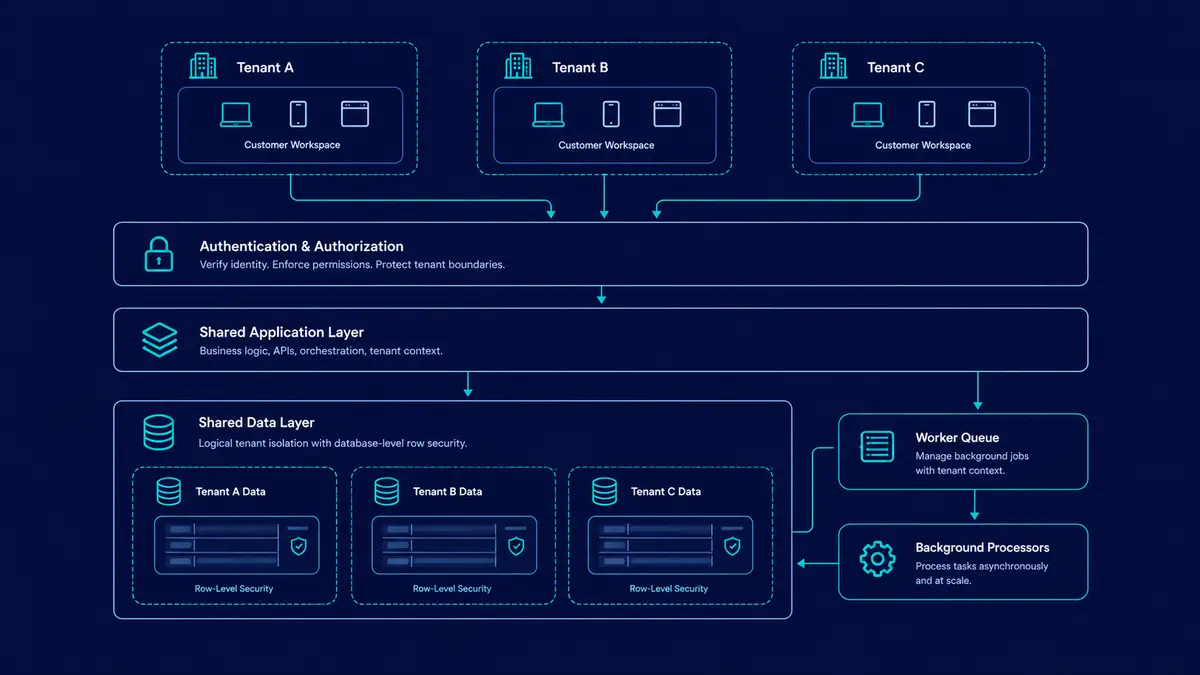
SaaS Architecture Best Practices: Patterns for Scalable Multi-Tenant Systems
Building a software-as-a-service (SaaS) platform introduces engineering constraints that differ significantly from building a single-tenant application. A SaaS platform may serve hundreds or thousands of organizations through shared application code and infrastructure, while each organization expects its data to remain private, its workflows to remain responsive, and its service to remain reliable.
Two architectural mistakes frequently create problems as SaaS products grow. The first is adopting distributed microservices before the product has stable domain boundaries or a genuine need for independent deployment and scaling. The second is treating tenant isolation as a query-filtering convention rather than a fundamental security requirement.
A scalable SaaS architecture must balance development speed, data isolation, operational complexity, and predictable performance. This guide examines practical patterns for establishing those boundaries, from choosing an application architecture to securing tenant data, propagating identity, and processing background workloads fairly.
1. Choosing the Right Application Architecture
The choice between a monolith, a modular monolith, and microservices should reflect the product's requirements, the team's structure, and the operational capabilities available to maintain the system.
Microservices are not inherently more scalable or reliable than a well-designed monolith. They introduce network communication, distributed failure modes, service discovery, deployment coordination, and additional observability requirements. Those costs are justified when independent services solve specific business or operational problems.
The Monolithic Baseline
A traditional monolith packages most application functionality into a single deployable application. It may contain the API layer, domain logic, authentication, billing workflows, and database access. Background workers can run as separate processes while sharing the same codebase.
Advantages include:
Straightforward local development and debugging.
Simpler deployment and operational monitoring.
Database transactions across related operations without distributed transaction coordination.
Lower infrastructure and networking overhead.
Faster iteration for small teams.
Potential limitations include:
Poorly isolated workloads can compete for CPU, memory, and database connections.
Tight coupling can make changes risky as the codebase grows.
A shared deployment can force unrelated features to ship together.
A process-level failure may affect multiple application capabilities.
These limitations are not inevitable. A monolith with explicit module boundaries, sensible resource limits, and well-designed background processing can support substantial growth.
The Modular Monolith: A Practical Default
A modular monolith keeps the application within one primary deployment unit while enforcing boundaries between business domains.
For example, a SaaS platform might define these modules:
Identity and organizations: Users, memberships, roles, and tenant resolution.
Billing and subscriptions: Plans, entitlements, invoices, and subscription lifecycle.
Core product: The primary business workflows.
Notifications: Email, in-app notifications, and delivery status.
Reporting: Aggregation, exports, and analytical queries.
Each module owns its domain logic and exposes a deliberate interface to other modules. Modules should avoid importing internal implementation details from one another or directly modifying another module's state.
A shared database can still be appropriate. Logical ownership does not require a separate database for every module. Instead, establish clear rules for which module owns each table, which interfaces other modules may use, and how cross-module operations are coordinated.
This architecture preserves the simplicity of a unified application while reducing coupling. It also creates clearer extraction boundaries if a particular module eventually needs independent deployment or scaling.
When Microservices Become Worthwhile
Extract a service when there is a concrete operational or organizational reason, such as:
Different resource requirements: An AI document-processing workload may need specialized compute and long-running workers, while the primary API requires predictable request latency.
Independent scaling: A high-volume ingestion pipeline may need to scale separately from ordinary customer-facing requests.
Independent team ownership: Multiple teams may need to deploy and operate distinct domains without coordinating every release.
Isolation or residency requirements: Certain customers may require specific data to remain in a designated region or environment.
Reliability boundaries: A failure-prone integration or resource-intensive workload may need stronger isolation from critical application operations.
Before extracting a service, identify the problem the new boundary will solve. A service that cannot be deployed, monitored, secured, and recovered independently may add complexity without delivering meaningful independence.
2. Multi-Tenancy and Database Isolation
Multi-tenancy allows multiple customer organizations to use the same application while maintaining separate identities, permissions, and data boundaries.
The central security requirement is that one tenant must not be able to read or modify another tenant's data without explicit authorization. This requirement applies to ordinary queries, background jobs, exports, administrative workflows, caches, file storage, and integrations.
There are three common database isolation models.
Isolation modelCost and resource useOperational complexityIsolation characteristicsShared database and shared schemaUsually the most resource-efficientLower baseline overhead, but requires disciplined tenant scopingLogical isolation depends on application controls and database policiesShared database with separate schemasModerate resource efficiencySchema provisioning and migrations become more complicated as tenant count growsSeparate namespaces, but shared database infrastructure and failure domainsDatabase per tenantOften higher infrastructure and management costsProvisioning, monitoring, backups, and migrations require automationStronger database-level separation and more tenant-specific operational control
The right model depends on customer requirements, regulatory obligations, operational capacity, and the cost of isolation. Dedicated databases are not automatically required for every enterprise customer, and pooled tenancy is not automatically unsuitable for regulated workloads. The relevant contracts, controls, and compliance requirements must determine the decision.
Model A: Shared Database, Shared Schema
In a pooled architecture, tenant records share database tables. Every tenant-scoped table should carry a tenant identifier, typically an organization_id or tenant_id, that references the owning organization.
For example:
CREATE TABLE workspace_projects (
    id UUID PRIMARY KEY DEFAULT gen_random_uuid(),
    tenant_id UUID NOT NULL
        REFERENCES organizations(id) ON DELETE CASCADE,
    name VARCHAR(255) NOT NULL,
    created_at TIMESTAMPTZ NOT NULL DEFAULT NOW()
);

CREATE INDEX idx_workspace_projects_tenant_id
    ON workspace_projects (tenant_id, id);
The composite index supports common access patterns that retrieve records belonging to one tenant. Additional indexes should reflect actual query patterns, including sorting and filtering requirements.
A tenant identifier alone does not enforce isolation. Application queries must still be scoped correctly, and the database should provide an additional enforcement layer where appropriate.
Enforcing Tenant Boundaries with PostgreSQL Row-Level Security
PostgreSQL Row-Level Security (RLS) allows database policies to restrict which rows a database role can access or modify.
A tenant policy can use a transaction-local setting to identify the active tenant:
ALTER TABLE workspace_projects
    ENABLE ROW LEVEL SECURITY;

CREATE POLICY workspace_projects_tenant_policy
ON workspace_projects
FOR ALL
USING (
    tenant_id = NULLIF(
        current_setting('app.current_tenant_id', true),
        ''
    )::UUID
)
WITH CHECK (
    tenant_id = NULLIF(
        current_setting('app.current_tenant_id', true),
        ''
    )::UUID
);
The two policy expressions serve related but distinct purposes:
USINGrestricts which existing rows are visible or eligible for modification.WITH CHECKvalidates the tenant identifier of rows created or modified by operations covered by the policy.
When the setting is absent or empty, the expression evaluates toNULL, which does not authorize a row under this policy. Invalid non-empty UUID values can raise a database error and should be handled appropriately.
For example, the application can establish the tenant context within a transaction:
BEGIN;

SELECT set_config(
    'app.current_tenant_id',
    $1,
    true
);

SELECT id, name
FROM workspace_projects
ORDER BY created_at DESC;

COMMIT;
Here, $1 represents a parameter supplied through the database driver's parameterized-query mechanism. The application must validate the tenant identifier and bind the value safely.
The third argument to set_config is true, which makes the setting local to the current transaction. It is reset when that transaction ends. The tenant context must therefore be established and used within the same transaction.
This is particularly important with connection pools. A transaction-local setting avoids leaving request-specific tenant state behind on a connection reused by another request. Every tenant-scoped operation must still execute within the transaction where the context was established.
Important security limitations:
A custom tenant setting is context, not proof of authorization. The application must authenticate the user, verify active membership in the requested organization, and check the user's permissions before setting the tenant context.
A custom setting can potentially be changed by SQL executed under the same database role. RLS based on that setting does not independently protect against arbitrary SQL injection or a compromised application that can freely choose tenant identifiers.
Table owners typically bypass RLS unless
FORCE ROW LEVEL SECURITYis enabled. Superusers and roles with theBYPASSRLSattribute can bypass RLS regardless.Production application connections should use a dedicated, least-privilege database role that does not own protected tables and does not have
BYPASSRLS. Policies must cover every relevant tenant-scoped table, with deliberate treatment of inserts, updates, deletes, and privileged maintenance operations.
For tables where the application role must not bypass policies, evaluate whether to enforce row-level security even for the table owner:
ALTER TABLE workspace_projects
    FORCE ROW LEVEL SECURITY;
Test these controls using the actual production application role and connection-pooling configuration. Include negative tests that attempt cross-tenant reads, inserts, updates, and deletes.
PostgreSQL's official documentation provides further details on Row Security Policies and configuration-setting functions.
Model B: Separate Schema per Tenant
In this model, each tenant receives a dedicated schema within a shared PostgreSQL database.
This can provide clearer logical separation and may simplify certain tenant-specific data-management operations. However, schemas still share database compute, storage, connections, and other infrastructure.
Operational costs increase as the tenant count grows:
Schema provisioning and lifecycle management must be automated.
Database migrations may need to run across many schemas.
Connection and catalog overhead can become significant.
Cross-tenant reporting requires deliberate data-access paths.
Restoring an individual tenant from a database-level backup may require restoring to an auxiliary instance and extracting the relevant schema.
Schema separation is therefore a trade-off, not a complete security guarantee. Database permissions, application authorization, backup procedures, and migration tooling remain essential.
Model C: Database per Tenant
A siloed model gives each tenant a separate database or database cluster. It can support stronger database-level separation and more independent operational controls.
Potential advantages include:
Tenant-specific backup and recovery policies.
Independent maintenance windows.
Dedicated compute resources and resource limits.
More flexibility for tenant-specific data residency or encryption requirements.
Reduced direct database-level blast radius between tenants.
However, a dedicated database does not automatically isolate shared application servers, credentials, message brokers, caches, or external services.
Costs also increase. Provisioning, connection management, monitoring, migration orchestration, backup verification, and disaster recovery must work across a growing fleet of databases.
A hybrid approach is often practical: keep most customers in a pooled database and offer a siloed deployment tier to customers with justified isolation, compliance, or performance requirements.
3. Identity, Authentication, and Tenant Context
A user and a tenant are different entities. One person may belong to several organizations, with different permissions in each.
A reliable SaaS identity model therefore separates:
User identity: Who authenticated?
Tenant identity: Which organization is being accessed?
Membership: Is the user an active member of that organization?
Authorization: Which actions may that user perform in the current context?
Entitlements: Which features or resource limits does the tenant's plan permit?
An email address or user role alone is not sufficient to authorize tenant access. Permissions must be evaluated against the active organization and the requested operation.
Resolving the Active Tenant
Common tenant-resolution approaches include:
Subdomain-based routing
acme.example.comThis provides a clear tenant-specific host, but subdomains require careful handling of domain ownership, host validation, and cookie scope. Cookies scoped to a parent domain can be shared across subdomains, so host-only cookies are preferable when cross-subdomain sharing is unnecessary.
Path-based routing
example.com/organizations/{organizationId}This avoids tenant-specific DNS configuration but makes it especially important to authorize the requested organization on every protected operation.
Session or token context
An authenticated session or token may identify the active organization. For example, a signed access token may contain an org_id claim. The server must still verify that the user remains authorized for that organization, taking token lifetime, membership changes, and revocation requirements into account.
Never trust a tenant identifier merely because it appears in a URL, request header, or client-side state.
Propagating a Verified Request Context
After authentication, tenant resolution, and membership checks, the application can create a request context for downstream services:
type TenantPlan =
  | "STARTER"
  | "PROFESSIONAL"
  | "ENTERPRISE";

type RequestContext = Readonly<{
  userId: string;
  tenantId: string;
  tenantPlan: TenantPlan;
  correlationId: string;
}>;

type MembershipRole =
  | "ADMIN"
  | "MEMBER"
  | "VIEWER";
The request context should be created by trusted server-side code, not copied directly from unverified client input.
Membership roles should be evaluated within the selected tenant. A user who is an administrator in one organization may have read-only access in another.
For HTTP APIs, distinguish common failure cases:
401 Unauthorized: Authentication is missing or invalid.
403 Forbidden: The authenticated user lacks the required permission.
404 Not Found: The resource does not exist, or the application intentionally conceals its existence from unauthorized callers.
The precise response policy should be consistent with the application's security and information-disclosure requirements.
Background jobs need the same discipline. A job should carry a validated tenant identifier and sufficient information to re-establish authorization and data scope at execution time. Do not assume that an authorization decision made when a job was enqueued remains valid indefinitely.
4. Background Processing and Tenant Fairness
A single tenant can generate enough work to degrade service for everyone else. For example, a large data export may consume CPU, memory, database connections, and worker capacity while ordinary notification or user-invitation jobs wait.
Message brokers and FIFO queues do not automatically guarantee fair scheduling. Fairness must be designed through queue organization, concurrency controls, admission policies, and workload monitoring.
Separate Workloads by Priority
One practical approach is to classify work according to its latency and resource requirements:
QueueTypical workloadsProcessing objectiveHigh priorityPassword-reset messages and critical webhook dispatchMinimize queue delayDefaultUser invitations and routine document processingPredictable completion timeBulkLarge exports, imports, and batch reportsProcess without starving interactive workloads
These are illustrative categories, not universal service-level guarantees. Actual objectives should be based on product requirements, measured workload characteristics, and downstream provider limits.
Priority queues should also be designed to avoid starving lower-priority work indefinitely.
Enforce Tenant-Aware Fairness
Several techniques can reduce noisy-neighbor effects:
Per-tenant concurrency limits: Restrict how many jobs one tenant may execute simultaneously.
Rate limiting: Limit job submission or processing using token buckets or other appropriate algorithms.
Fair scheduling: Rotate among active tenant queues or use weighted scheduling to distribute worker capacity.
Workload isolation: Run CPU-intensive or memory-intensive jobs in separate worker pools.
Admission control: Reject, defer, or throttle work when a tenant exceeds its configured limits.
Idempotent job execution: Make retries safe so transient failures do not create duplicate side effects.
A per-tenant concurrency limit should be paired with global capacity limits. Otherwise, many individually compliant tenants can still overwhelm the system collectively.
Queue observability should include queue age, wait time, processing duration, retry rate, failure rate, and workload distribution across tenants. Track these metrics without exposing sensitive tenant data in logs or monitoring labels.
5. Caching, Rate Limits, and Resource Isolation
Database isolation alone does not make a multi-tenant application secure or predictable. Other shared resources can introduce cross-tenant data exposure and performance problems.
Cache Isolation
Tenant-specific cache keys should include the tenant identifier and any other relevant authorization dimensions.
For example:
const cacheKey =
  `tenant:${tenantId}:project:${projectId}`;
This is an illustrative naming pattern, not a complete cache-security mechanism. The server must authorize the request before returning cached data, and the key must account for any differences in visibility or permissions that affect the cached result.
Shared cache entries are appropriate only when the data is genuinely safe to share across the relevant users and tenants.
Rate Limiting and Quotas
Use a combination of controls to protect shared infrastructure:
Per-user limits for abusive request patterns.
Per-tenant limits for aggregate consumption.
Endpoint-specific limits for expensive operations.
Global limits to protect database connections and downstream services.
Plan-based quotas where they reflect documented product entitlements.
Rate limiting should be enforced on the server. Client-side throttling improves user experience but is not a security boundary.
Resource quotas should be measurable, documented, and enforced consistently across HTTP requests, scheduled tasks, and background jobs.
Observability Without Leaking Tenant Data
Structured logs and traces should include useful operational context, such as a correlation identifier and, where appropriate, an internal tenant identifier.
Avoid logging access tokens, passwords, session secrets, sensitive request bodies, or unnecessary personal information. Restrict access to logs and monitoring systems, and establish retention policies that reflect security and privacy requirements.
Observability should help answer questions such as:
Which workload is causing elevated latency?
Are errors concentrated in one service or tenant?
Is a tenant approaching a resource limit?
Are background jobs repeatedly retrying?
Are database connection pools saturated?
The goal is to identify operational problems without creating a secondary source of sensitive customer information.
6. An Incremental Architecture Roadmap
Architecture should evolve as evidence accumulates. A practical progression is to establish clear boundaries early, strengthen resource controls as usage grows, and introduce more expensive isolation only when requirements justify it.
Phase 1: Early Traction
Start with a small set of well-understood components:
A modular monolith with explicit domain boundaries.
A pooled PostgreSQL database when its isolation model fits the product.
Comprehensive tenant authorization and tested database policies where appropriate.
A managed queue or simple background-worker system for asynchronous tasks.
Structured logs, error reporting, and basic latency monitoring.
Automated deployment, backups, and recovery procedures.
Prioritize correctness and operational visibility over architectural novelty.
Phase 2: Growing Usage
As usage and workload diversity increase:
Separate background workers from latency-sensitive API processes.
Add read replicas when measured read workloads justify them.
Introduce per-tenant quotas and rate limits.
Improve query plans, indexes, and connection-pool management.
Track queue latency, database saturation, and tenant-level resource consumption.
Automate migration, backup, and restore testing.
A read replica can improve some read-heavy workloads, but it introduces replication lag and does not eliminate contention on the primary database.
Phase 3: Enterprise Requirements
When enterprise requirements or measured constraints justify more isolation:
Introduce dedicated database tiers for tenants that need them.
Consider sharding when a single database can no longer meet capacity or operational requirements.
Extract independently scalable services with clear ownership and deployment boundaries.
Add regional data placement when residency, latency, or contractual requirements demand it.
Strengthen disaster recovery, audit logging, access controls, and operational runbooks.
Do not adopt every item in this phase by default. Each change should solve a demonstrated problem and have a clear operational owner.
Conclusion
Scalable SaaS architecture is not about choosing the most distributed system or the most isolated database. It is about establishing the right boundaries for the product's current requirements while preserving a practical path for future growth.
A well-structured modular monolith can support rapid development without sacrificing domain clarity. A carefully implemented multi-tenant data model, supported by application authorization and appropriately configured database policies, helps protect customer data. Tenant-aware scheduling, resource quotas, and observability help maintain predictable service as workloads grow.
At Aformix, we approach software architecture with an emphasis on maintainable systems, explicit security boundaries, and infrastructure decisions grounded in real operational needs. The goal is to build systems that can grow with the business without introducing unnecessary complexity before it is needed.