
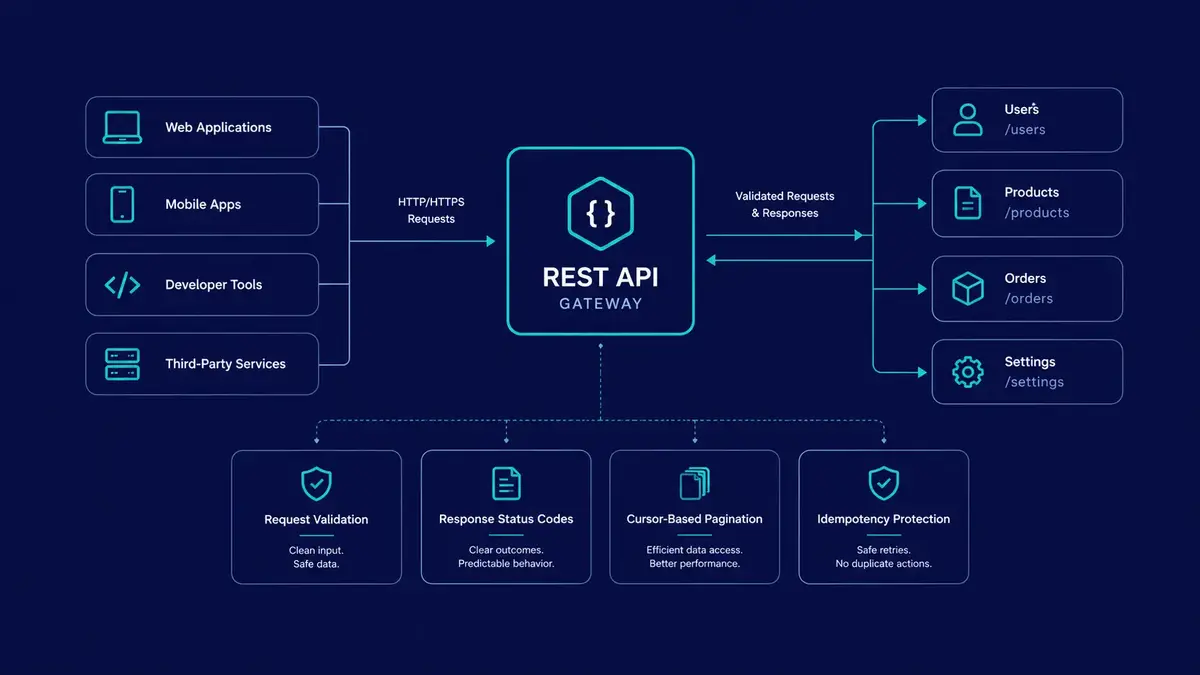
API Design Principles for Modern Web Applications: REST Semantics, Error Handling, and Idempotency
In modern software engineering, an Application Programming Interface (API) is more than a communication layer between frontend clients and backend servers. It is a long-term contract between systems. Once mobile applications, third-party integrations, and enterprise partners depend on an API, changing endpoint structures, field types, authentication requirements, or error behavior can introduce significant compatibility problems.
Designing a reliable API requires more than following naming conventions. It means defining predictable resource models, respecting HTTP semantics, returning consistent errors, controlling access to expensive operations, and handling retries safely when networks fail.
This guide explores practical principles for designing production-ready REST APIs, including resource modeling, HTTP methods and status codes, standardized error responses, cursor-based pagination, idempotency keys, rate limiting, and API versioning. It also explains common implementation pitfalls and how engineering teams can avoid them.
1. Resource Modeling and URL Structure
RESTful APIs organize functionality around resources, typically represented by nouns rather than action-oriented endpoint names. Consistent URL structures make an API easier to understand, document, test, and maintain.
Use consistent resource names
Plural nouns are a common convention for collection endpoints:
GET    /v1/projects
POST   /v1/projects
GET    /v1/projects/proj_123
PATCH  /v1/projects/proj_123
DELETE /v1/projects/proj_123
These endpoints represent the following operations:
GET /v1/projectsretrieves a collection of projects.POST /v1/projectscreates a project.GET /v1/projects/proj_123retrieves one project.PATCH /v1/projects/proj_123partially updates a project.DELETE /v1/projects/proj_123requests deletion of a project.
The exact response behavior depends on the API contract. For example, a successful deletion might return 204 No Content, while a soft-delete implementation might preserve the record internally for audit or recovery purposes.
Keep nested resources manageable
Nested URLs can express relationships clearly, but excessive nesting makes endpoints difficult to maintain.
For example, this endpoint may be unnecessarily complex:
GET /v1/organizations/org_123/departments/dept_456/projects/proj_789/tasks/task_001If the task has a globally unique identifier and the caller's authorization can be checked independently, a simpler endpoint may be sufficient:
GET /v1/tasks/task_001Use nesting when the parent-child relationship provides meaningful context or when the parent's scope is important to the operation. Keep authorization checks independent of URL simplicity: a predictable identifier must never grant access by itself.
Model business operations deliberately
Not every business operation maps neatly to basic CRUD. Payments, invitations, approvals, and archival workflows often represent explicit domain actions.
For example:
POST /v1/invoices/inv_123/pay
POST /v1/workspaces/ws_123/archive
POST /v1/projects/proj_123/invitations
These endpoints can be reasonable when the operation has clear business semantics. An alternative is to model the operation as a resource:
POST /v1/invoices/inv_123/paymentsChoose a pattern that makes the action, its side effects, and its response contract easy to understand. Avoid creating different conventions for similar operations without a good reason.
2. HTTP Semantics: Methods, Safety, and Status Codes
HTTP methods communicate the intended behavior of a request. Following their semantics improves interoperability with clients, caches, proxies, monitoring tools, and other infrastructure.
Choosing an HTTP method
MethodSafe?Idempotent by HTTP semantics?Typical purposeGETYesYesRetrieve a resourcePOSTNoNot guaranteedCreate a resource or initiate an operationPUTNoYesCreate or replace a resource at a known URIPATCHNoNot guaranteedPartially modify a resourceDELETENoYesRequest removal of a resource
A method is safe when the client is not requesting a state-changing operation. It is idempotent when repeating the same request has the same intended effect as performing it once.
Idempotency does not necessarily mean every response must be identical. For example, repeating a successful deletion might return 404 Not Found after the resource has disappeared, depending on the API contract, while the intended deletion effect remains idempotent.
PATCH deserves particular attention. It is not inherently idempotent, but an individual PATCH operation can be designed to be idempotent. Setting a project's name to a specific value can be idempotent; incrementing a counter or appending an item to a list might not be.
Return status codes that match the outcome
Use HTTP status codes to communicate what happened rather than returning 200 OK for every outcome.
StatusRecommended use200 OKThe request succeeded and a response representation is returned201 CreatedThe request created a resource202 AcceptedThe request was accepted for processing, but processing is not complete204 No ContentThe request succeeded and no response body is returned400 Bad RequestThe request cannot be processed because of malformed syntax or invalid request structure401 UnauthorizedAuthentication is missing or invalid403 ForbiddenThe caller is authenticated but is not permitted to perform the operation404 Not FoundThe resource does not exist, or the API intentionally conceals its existence409 ConflictThe request conflicts with the current state of a resource422 Unprocessable ContentThe request is understood, but its instructions cannot be processed because of validation or semantic constraints429 Too Many RequestsThe client has exceeded an applicable rate limit500 Internal Server ErrorAn unexpected server-side failure occurred
A 201 Created response should generally include a Location header identifying the created resource when its URI is known. The response may also include the created representation. The exact contract should be documented consistently.
Use 202 Accepted for asynchronous operations only when the API clearly explains how clients can determine whether processing has completed. A response might include an operation identifier or a URL where the operation's status can be retrieved.
For example:
HTTP/1.1 201 Created
Location: /v1/projects/proj_123
Content-Type: application/json
{
"id": "proj_123",
"name": "Mobile Redesign",
"status": "ACTIVE"
}Authentication and authorization errors also deserve careful handling. A 401 response may include an appropriate WWW-Authenticate challenge, depending on the authentication scheme. In multi-tenant systems, an API may return 404 instead of 403 when revealing that a resource exists would disclose sensitive information.
3. Predictable Error Handling with RFC 9457
Clients should not have to parse inconsistent error strings or infer failures from arbitrary response fields. A standardized error contract makes frontend validation, mobile error handling, logging, and integration testing more reliable.
RFC 9457, Problem Details for HTTP APIs, defines a standard format for communicating details about HTTP errors. It supersedes RFC 7807.
A response can use the application/problem+json media type:
HTTP/1.1 422 Unprocessable Content
Content-Type: application/problem+json
{
"type": "https://api.example.com/errors/validation-failed",
"title": "Validation Failed",
"status": 422,
"detail": "The request contains fields that violate validation rules.",
"instance": "/v1/projects",
"invalidParams": [
{
"field": "title",
"reason": "Title must be between 5 and 150 characters."
},
{
"field": "slug",
"reason": "Slug must contain only lowercase letters, numbers, and hyphens."
}
]
}The standard defines members such as type, title, status, detail, and instance. The invalidParams array in this example is an application-specific extension, not a required RFC 9457 member. An API can define its own extensions when they are documented and consistently applied.
Useful practices include:
Keep the HTTP status code authoritative for the response status.
Use stable problem types so clients can distinguish categories of failures.
Return field-level validation details when they help users correct a request.
Avoid exposing stack traces, database internals, access tokens, or sensitive implementation details.
Use a consistent error format across endpoints.
Include a request or correlation identifier where useful for troubleshooting.
For example, a frontend can display field-level validation messages next to form inputs while reporting unexpected server errors through a separate notification.
The objective is not to expose every internal detail. It is to give clients enough structured information to recover safely and predictably.
4. Scalable Pagination: Offset-Based and Cursor-Based Approaches
Collection endpoints need explicit pagination limits. Returning thousands of records in a single response can increase database workload, memory consumption, network transfer time, and client rendering costs.
Two common strategies are offset pagination and cursor pagination.
Offset pagination
An offset-based query might look like this:
SELECT id, name
FROM projects
ORDER BY id
LIMIT 20 OFFSET 1000;
This approach is straightforward and often works well for small datasets, administrative screens, and interfaces that need direct access to numbered pages.
However, large offsets can become expensive because the database may need to traverse and discard many preceding rows. The actual cost depends on the database engine, indexes, query plan, and data distribution.
Offset pagination can also produce confusing results when records are inserted or deleted between requests. A row may shift from one page to another, potentially causing a client to see duplicates or miss records.
Cursor pagination
Cursor pagination uses a value from the current result set to determine where the next page should begin.
For a table ordered by a unique, indexed identifier, a query could look like this:
SELECT id, name
FROM projects
WHERE id > :last_seen_id
ORDER BY id ASC
LIMIT 20;
The last_seen_id value acts as a cursor. This query can use an appropriate index to seek directly into the relevant range rather than discarding a large offset.
In practice, the ordering must be stable and deterministic. If a sort field is not unique, include a unique tie-breaker. For example:
SELECT id, name, created_at
FROM projects
WHERE (created_at, id) > (:last_created_at, :last_id)
ORDER BY created_at ASC, id ASC
LIMIT 20;
The exact tuple-comparison syntax and index strategy depend on the database. Equivalent conditions can be expressed explicitly when necessary.
Cursor pagination can significantly improve deep-page performance when the query and indexes are designed appropriately. It does not guarantee constant-time execution or sub-millisecond responses. Database load, filters, joins, row distribution, and index selection all affect performance.
It also does not automatically provide a consistent snapshot of a changing dataset. If records are inserted or updated during traversal, the behavior depends on the sort keys and consistency model. Applications that require snapshot-like traversal may need additional mechanisms, such as a fixed upper boundary, a snapshot timestamp, or database-supported snapshot isolation.
Define a predictable response format
A cursor-based endpoint might return:
{
  "data": [
    {
      "id": "proj_01H1",
      "name": "Mobile Redesign"
    },
    {
      "id": "proj_01H2",
      "name": "Cloud Migration"
    }
  ],
  "pagination": {
    "nextCursor": "eyJpZCI6InByb2pfMDFIMiJ9",
    "hasMore": true
  }
}
The cursor shown here is illustrative. In production, clients should treat cursors as opaque tokens rather than constructing or modifying them.
A robust pagination contract should specify:
The maximum permitted page size.
The default ordering and tie-breaker.
Whether cursors expire.
How filters and sort options interact with cursors.
What happens when a cursor is malformed or no longer valid.
Whether the API promises a stable snapshot or only best-effort traversal.
For frequently changing collections, cursor pagination is often a strong choice. Offset pagination remains useful when direct page navigation is important and dataset size is manageable.
5. Distributed Safety: Idempotency Keys
Network failures create an important problem for state-changing requests. A client might submit a payment or create a resource, but lose its connection before receiving the response. It cannot know whether the server completed the operation.
Blindly retrying the request can create duplicate resources or trigger the same business operation more than once.
An idempotency key lets a client identify retries of the same logical operation.
Example request
POST /v1/invoices/inv_123/payments
Idempotency-Key: 9b1deb4d-3b7d-4bad-9bdd-2b0d7b3dcb6d
Content-Type: application/json
{
"amount": 2500,
"currency": "USD"
}The example amount and currency are illustrative. A real API must define the expected units, currency rules, and validation requirements.
When the client retries the same logical operation, it sends the same idempotency key. The server can then recognize the retry and return the stored result instead of blindly repeating the business mutation.
Design the idempotency lifecycle carefully
A production implementation should address more than a cache lookup.
1. Scope the key correctly. Associate the key with the authenticated caller or tenant, operation, and endpoint as appropriate. Prevent one tenant from replaying or accessing another tenant's results.
2. Reserve the key atomically. Concurrent requests using the same key must not both proceed as independent operations. Use an atomic insert, uniqueness constraint, lock, or equivalent concurrency-control mechanism.
3. Bind the key to the request. Store a request fingerprint or equivalent representation. If the same key is reused with a different payload, reject the request according to the documented contract rather than returning an unrelated prior result.
4. Coordinate the business mutation and stored result. Where possible, persist the idempotency record and business changes within a transaction. For external payment providers or other systems that cannot participate in the same database transaction, use the provider's idempotency mechanism where available and design explicit recovery and reconciliation procedures.
5. Handle in-progress operations. If a second request arrives while the first is still running, define whether the server waits, returns a conflict, or indicates that processing is in progress.
6. Define retention and recovery. Keys need a documented retention period. The system must also handle crashes, timeouts, and operations whose outcome is uncertain.
A simplified lifecycle looks like this:
Client submits request with key
             |
             v
Atomically reserve or find key
             |
       +-----+------+
       |            |
   New key       Existing key
       |            |
       v            v
Validate request   Check request fingerprint
       |            |
       v            +--> Mismatch: reject
Execute operation  |
       |            +--> Completed: replay result
       v            |
Persist result      +--> In progress: apply documented behavior
       |
       v
Return response
For a payment operation, the objective is to prevent duplicate business effects, not merely to return the same HTTP response. A durable record, concurrency control, and reconciliation strategy are essential parts of that guarantee.
Idempotency keys are particularly useful for payments, order creation, provisioning, and other operations where a duplicate request could have meaningful consequences. They complement, rather than replace, database constraints and domain-level safeguards.
6. Defensive Rate Limiting
APIs can be affected by brute-force attempts, automated abuse, accidental retry loops, and legitimate traffic spikes. Rate limiting helps protect system availability and controls how much work a caller can trigger within a defined period.
The right policy depends on the API's threat model and resource costs. Authentication endpoints, expensive reports, public search endpoints, and payment operations may need different limits.
Choose a policy that matches the workload
Common approaches include:
Fixed window: Counts requests within discrete time windows. It is simple to implement but can allow bursts around window boundaries.
Sliding window: Tracks usage across a moving interval to provide smoother enforcement.
Token bucket: Allows controlled bursts while limiting the average request rate.
Concurrency limits: Restrict the number of expensive operations running at the same time.
Limits can be applied by account, tenant, API key, IP address, endpoint, or a combination of these. IP-only limits are often insufficient for authenticated multi-tenant systems, while account-only limits may not adequately protect unauthenticated endpoints.
In distributed deployments, the enforcement mechanism must account for multiple application instances. A centralized store, API gateway, reverse proxy, or distributed rate-limiting service can help maintain consistent limits across the deployment.
Communicate limits clearly
When a request exceeds a limit, return 429 Too Many Requests when appropriate. A Retry-After header can tell the client how long to wait before retrying.
For example:
HTTP/1.1 429 Too Many Requests
Content-Type: application/problem+json
Retry-After: 14
{
"type": "https://api.example.com/errors/rate-limit-exceeded",
"title": "Too Many Requests",
"status": 429,
"detail": "The request limit has been reached. Retry after the indicated delay."
}Rate-limit metadata can also help clients adapt their behavior. If an API publishes fields such as RateLimit-Limit, RateLimit-Remaining, or RateLimit-Reset, it should document their meaning and follow the specification or convention it has chosen. These exact header names should not be presented as universally required on every API.
Clients should respect Retry-After when supplied, use bounded retries, and apply exponential backoff with jitter when appropriate. Retrying immediately in a tight loop can amplify the very overload that caused the limit to be reached.
Rate limiting should be complemented by authentication, authorization, input validation, monitoring, and resource-specific safeguards. It is one layer of defense, not a complete security strategy.
7. API Versioning and Backward Compatibility
An API becomes harder to change as more clients depend on it. Mobile applications may remain installed for months, third-party integrations may deploy infrequently, and enterprise clients may require scheduled upgrades.
The safest approach is to treat compatibility as a design constraint.
Prefer additive changes
Changes that often preserve compatibility include:
Adding an optional response field.
Adding a new endpoint.
Introducing a new optional request parameter.
Adding a new resource representation while preserving existing behavior.
Even additive changes can break poorly designed clients, especially when consumers reject unknown fields or depend on undocumented response shapes. Compatibility should be tested against actual client behavior.
Potentially breaking changes include:
Removing or renaming a field.
Changing a field's type or meaning.
Making an optional request field mandatory.
Changing authentication requirements.
Altering status codes or error response structures.
Changing pagination ordering or default filtering.
Document the API contract and use automated contract tests to catch unintended changes.
Choose a versioning strategy deliberately
A common strategy is URL-based versioning:
/v1/projects
/v2/projects
Other approaches include media-type versioning or explicit version headers. Each has trade-offs in discoverability, routing, caching, and client implementation.
Versioning does not eliminate the need for compatibility planning. Teams should define deprecation policies, communicate migration timelines, monitor usage of older versions, and avoid removing versions until their support commitments have been addressed.
For APIs consumed by mobile applications, backwards compatibility is particularly important because clients may not update immediately after a new release.
8. Security and Operational Reliability
Good API design also requires consistent security boundaries and observable behavior.
Validate input at the boundary
Validate request bodies, query parameters, path identifiers, and headers before they reach business logic. Enforce length limits, allowed values, expected types, and domain rules.
Validation is not a substitute for authorization. A request can be syntactically valid and still be forbidden.
Enforce authorization on every relevant operation
Check whether the authenticated principal can access the requested resource and perform the requested action. In multi-tenant systems, tenant isolation must be enforced in the server-side data-access layer, not merely by filtering data in the frontend.
Avoid trusting a client-supplied tenant ID or resource identifier as proof of ownership.
Make retries and timeouts explicit
Document timeout expectations and identify which operations can safely be retried. Read operations are generally easier to retry, while state-changing requests may need idempotency controls.
Set reasonable limits for request bodies, execution time, concurrent work, and expensive queries. Use asynchronous processing for work that cannot reliably complete within the API's response-time budget.
Observe failures without leaking secrets
Capture structured logs, request identifiers, latency measurements, error rates, and relevant operational metrics. Avoid logging credentials, access tokens, payment data, or other sensitive information.
Monitoring should help teams distinguish client errors, infrastructure failures, authorization problems, and overload. Those distinctions make production incidents easier to diagnose.
Conclusion
Exceptional API design is an exercise in creating dependable contracts between systems and the developers who use them. Consistent resource modeling makes endpoints predictable. Correct HTTP semantics clarify outcomes. Standardized error responses simplify client recovery. Well-designed pagination controls the cost of retrieving large collections. Idempotency mechanisms protect state-changing operations from duplicate effects, while rate limiting and compatibility planning support reliability as usage grows.
These practices are not a substitute for testing, monitoring, or thoughtful domain modeling. They provide a foundation on which those activities can work effectively.
At Aformix, we build our own software products and also take on client work, including custom web development, WordPress development, SEO, and software and SaaS engineering. We approach API design as part of that broader engineering discipline: creating interfaces that are understandable, maintainable, and appropriate for the systems that depend on them.